
Kacchapa Jātaka
Kacchapa Jātaka
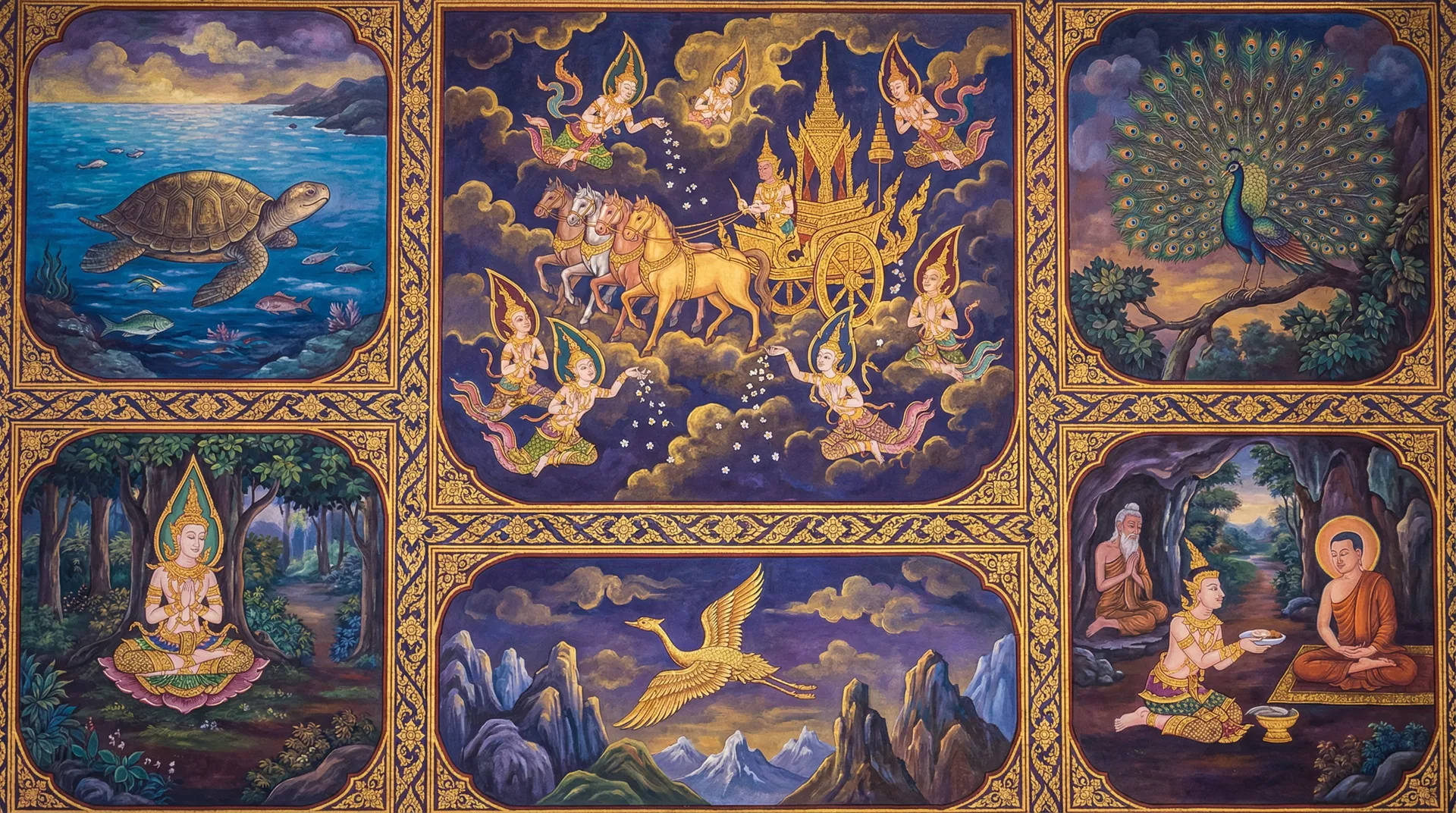
In a time long past, when the Himalayas stood as young giants and the rivers flowed with pristine clarity, there lived a Bodhisattva in the form of a great tortoise. This tortoise was no ordinary creature; he was immense in size, his shell as vast and sturdy as a mountain peak, and his wisdom profound. He dwelled in a serene lake high in the mountains, a sanctuary of peace where he meditated and contemplated the nature of existence.
One year, the rains failed. The skies remained stubbornly clear, and the sun beat down relentlessly. The lake, the tortoise's home, began to shrink, its once vast expanse reducing to a muddy puddle. The other creatures that relied on the lake – the fish, the deer, the birds – grew desperate. They huddled together, their spirits wilting with the parched earth, their thirst unquenchable.
A delegation of these animals, led by a wise old crane, approached the great tortoise. "O venerable Kacchapa," the crane croaked, his voice dry and raspy, "our home is drying up. The fish are gasping for air, the deer are weakening, and we ourselves are on the brink of despair. We have heard of your great wisdom and your immense strength. Is there anything you can do to save us?"
The Bodhisattva tortoise, seeing the suffering of his fellow creatures, felt a deep pang of compassion. He knew that his own life was sustained by the remaining water, but he could not bear to see so many perish while he survived. He thought deeply, his ancient mind searching for a solution that would benefit all.
"My dear friends," the tortoise said, his voice slow and resonant, carrying the weight of ages, "this drought is a great trial. While I cannot summon rain, I may be able to lead you to a place of safety. There is a great river, far to the south, where the waters are always abundant. But the journey is long and perilous, fraught with dangers. Those who are weak or fearful may not survive."
The animals listened intently, a glimmer of hope in their weary eyes. The crane, however, voiced their shared concern. "But how shall we, the weaker creatures, make such a journey? The deer are already faltering, and the fish... they cannot survive on land."
The tortoise then revealed his plan. "I will carry you," he declared. "My shell is strong, and my determination is unwavering. I will carry as many of you as I can, making my way south. But you must promise me one thing: absolute silence. For if you speak, if you cry out or lament, you may disturb my concentration, and we could all perish."
The animals readily agreed, their desperation outweighing any apprehension. The tortoise carefully arranged the animals on his vast shell. He took the deer, the smaller birds, and even some of the fish, carefully placing them in depressions and crevices, ensuring they were secure and could breathe. Then, with a mighty effort, he slid into the muddy remnants of the lake and began his arduous journey south.
The journey was indeed challenging. The sun beat down, and the land was dry and cracked. The tortoise moved slowly but steadily, his ancient muscles straining with each step. The animals on his back remained silent, their trust in the Bodhisattva absolute. They felt the heat, the discomfort, the gnawing fear, but they remembered their promise and remained quiet, their eyes fixed on the horizon.
After many days of travel, they approached the foothills of a lower mountain range. The air grew slightly cooler, and the terrain became more rugged. As they navigated a particularly steep and treacherous path, the tortoise had to exert immense effort. His muscles ached, his breathing grew heavy, and the weight on his shell felt immense.
At this critical juncture, one of the young deer, overwhelmed by the discomfort and the fear of falling, forgot his promise. "Are we there yet?" he cried out, his voice a desperate squeak.
The moment the words left the deer's mouth, the tortoise's concentration faltered. The immense weight shifted, and the great creature lost his footing on the steep incline. With a terrible groan, he began to slide down the mountainside, his precious cargo thrown about in a chaotic tumble. The fish, the birds, the deer – all were flung from his shell, scattering across the rough terrain.
The tortoise himself rolled to the bottom, bruised and battered, but alive. He looked up, his heart heavy with sorrow, to see the other animals struggling to rise, injured and disoriented. His great effort, his selfless act of compassion, had been undone by a single moment of lost discipline.
He managed to reach the fallen animals. "My friends," he said, his voice filled with grief, "my strength was not enough. Your silence was our shield, and its breaking has led to this misfortune. While I regret that I could not complete the journey, I pray that you will find the strength to continue, and perhaps find the river on your own."
Though disheartened, the animals understood. They had witnessed the tortoise's incredible sacrifice. They tended to their wounds as best they could, and though many were lost on the way, some of the stronger ones, remembering the tortoise's words, managed to eventually find their way to the great river, forever grateful for the immense effort and compassion of the Bodhisattva tortoise.
The tortoise, though saddened by the outcome, did not despair. He understood that while compassion and strength are vital, discipline and the ability to follow instructions are equally crucial for overcoming obstacles. He returned to his mountain home, which had thankfully received some rain, and continued to live a life of wisdom and contemplation, his heart filled with the enduring lesson of the Kacchapa Jātaka: that even the noblest intentions and the greatest efforts can be undermined by a lack of discipline and the failure to adhere to crucial instructions.
— In-Article Ad —
💡Moral of the Story
Great efforts and noble intentions are essential, but they must be accompanied by discipline and the adherence to instructions. A single lapse in concentration or a breach of trust can undo immense progress and lead to tragic consequences.
Perfection: Patience (Khanti)
— Ad Space (728x90) —
More Jataka Tales You May Enjoy
 413Sattakanipāta
Sankha-Jataka
Sankha-JatakaIn the bustling city of Varanasi, amidst a labyrinth of narrow lanes and vibrant market...
💡 True wealth is not measured in material possessions, but in the knowledge and compassion that enable us to serve others and alleviate suffering. Youthful impetuosity, if unchecked, can lead to great regret.
 292Tikanipāta
Kaccānuppāda Jātaka
The Tale of the Unfortunate ProgenyIn the ancient city of Varanasi, a king named Brahmadatta reigned...
💡 True vision comes not from the eyes, but from the heart. Empathy and compassion are the most powerful tools for leadership and for alleviating suffering.
 392Chakkanipāta
Moggallana Jataka
Moggallana JatakaIn the ancient land of Savatthi, there lived a wealthy merchant named Punna. He was...
💡 Generosity and devotion to the Dharma are powerful virtues that lead to immense merit and spiritual growth. True wealth is found in giving.
390ChakkanipātaSaddhanta Jataka
Saddhanta JatakaIn a thriving city known for its bustling marketplace and its scholarly pursuits, th...
💡 Honesty and integrity are paramount, even in the face of severe consequences. True value lies not in outward perfection, but in truthfulness and the courage to admit one's flaws.
 501Pakiṇṇakanipāta
Mūkapacca Jātaka
Mūkapacca Jātaka In the ancient kingdom of Mithila, nestled amidst verdant plains and traversed by t...
💡 True wisdom and strength are often found in quiet contemplation and keen observation, rather than in outward pronouncements. A lack of outward expression does not signify a lack of understanding or capability; indeed, it can foster deeper insight.
284TikanipātaMahāpaduma Jātaka
Mahāpaduma JātakaIn the heart of a lush forest, far from the clamor of human settlements, lived a Bo...
💡 True beauty and value lie within the heart, not in external possessions or trophies. Greed and cruelty ultimately lead to sorrow and regret.
— Multiplex Ad —